
Stop Guessing: How the Opportunity Checklist Keeps Your Deals on Track?
You've had a great discovery call. The client seemed interested. You move the opportunity to the next stage... but did you actually confirm they have budget? Did you identify who makes the final decision? Two months later, the deal stalls, and you can't figure out why.
Sound familiar? Moving deals forward based on gut feeling instead of concrete evidence is one of the biggest pipeline killers in B2B sales.
Why This Matters
When opportunities move through stages without clear criteria, three things happen:
Your forecast becomes fiction. If deals sit in "Qualification" for weeks without real qualification happening, your pipeline numbers mean nothing. Leadership can't plan, and you can't prioritize.
You waste time on dead deals. Without checkpoints, "zombie opportunities" linger in your pipeline—deals that look alive but will never close. You keep following up on prospects who were never serious buyers.
You lose winnable deals. Sometimes the opposite happens: you rush to proposal stage without confirming the client's real pain points. The deal falls apart because you skipped a critical step.
The Opportunity Checklist solves this by giving you a clear roadmap: complete these tasks before moving forward. No guessing. No skipping steps. Just a clean, repeatable process.
Understanding the Checklist: Your GPS for Every Deal
Think of the Opportunity Checklist like a pilot's pre-flight checklist. Before takeoff, pilots don't rely on memory or intuition—they go through every item systematically. Not because they're forgetful, but because skipping one step could be catastrophic.
Your sales process works the same way. Each stage of your opportunity has specific "exit criteria"—things that must be true before you can confidently move to the next stage.
The checklist in Salesforce makes these criteria visible and trackable. Instead of asking yourself "Did I cover everything?", you simply look at the list.
What Should Be on the Checklist? Examples by Stage
Every organization is different, but here are typical exit criteria that work well for B2B sales. Use these as inspiration when discussing checklist items with your team.
Discovery
Mandatory: Client acknowledged a problem that we can solve.
Optional: "Champion" identified (internal advocate who will push for your solution).
Qualification
Mandatory: Budget confirmed or procurement path defined.
Mandatory: Timeline established (when do they need this solved?).
Optional: Buying Committee mapped (who else needs to approve?).
Solution
Mandatory: Client confirms the solution meets their technical requirements.
Mandatory: Client confirms the solution meets their business requirements.
Optional: No critical "showstoppers" identified.
Negotiation/Review
Mandatory: Commercial terms agreed upon by both parties.
Optional: Legal/Board has approved the contract terms.
Commitment
Mandatory: Contract signed.
Optional: Deposit invoice paid (if applicable).
💡 Pro Tip: Notice how mandatory items focus on facts you can verify ("budget confirmed"), while optional items often relate to relationships or internal client dynamics ("champion identified"). Start with fewer mandatory items—you can always add more once your team gets comfortable with the process.
How to Use the Opportunity Checklist
Implementation Difficulty: ⭐⭐⭐⭐☆ (4/5)
Development Required: Custom Flow
Time to Implement: 2-4 hours
What You'll See
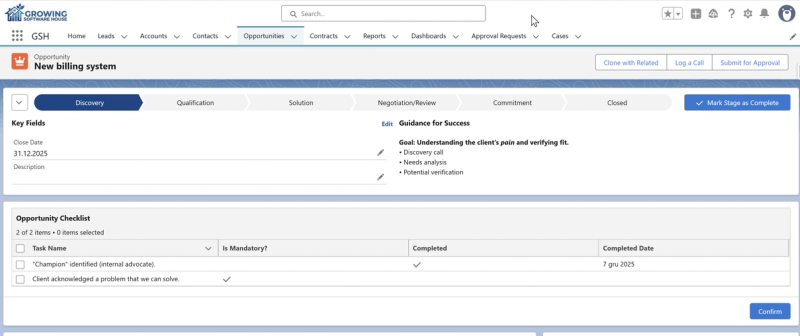
When you open an Opportunity and look at the stage path, you'll notice the checklist appears as a related list or panel. Each stage has its own set of tasks—specific actions or confirmations you need to complete.
Two types of checklist items exist:
Mandatory items (marked with a checkmark in the "Is Mandatory?" column) — You cannot move to the next stage until these are done. These are your hard gates. For example: "Client acknowledged a problem that we can solve" is non-negotiable before leaving Discovery.
Optional items — Best practices that strengthen your deal, but won't block your progress. For example: "Champion identified (internal advocate)" is valuable but might not always be possible to confirm early.
Working With the Checklist Daily
Before your calls: Open the opportunity and review what's still unchecked for the current stage. This tells you exactly what to focus on during your conversation. Walking into a Qualification call? Make sure you're ready to discuss budget and map the decision-makers.
After your calls: Update the checklist immediately while the conversation is fresh. Did the client confirm their timeline? Check it off. Did they mention who else needs to approve? Note it and check that box.
When moving stages: Click "Mark Stage as Complete" only when you've genuinely completed the required items. If the system prevents you from moving forward, that's not a bug—it's protection. Go back and do the work.
Pro Tips
💡 Don't check boxes just to move forward. It's tempting to mark "Budget confirmed" as complete because the client said "we have money for the right solution." That's not confirmation—that's optimism. Real budget confirmation means a specific number discussed and approved internally.
💡 Use the checklist as your meeting agenda. Before every client interaction, look at what's unchecked. Those items become your talking points.
💡 The "Completed Date" field is your friend. It creates a timeline of your deal's progress. If a deal stalls later, you can look back and see exactly when each milestone was hit—useful for diagnosing what went wrong.
Real-World Example: See It In Action
The Scenario: Tom is working an opportunity with Caldwell, Ferrell and Richmond. He's had two good discovery calls and feels ready to move into Qualification.
The Checklist Check: Before clicking "Mark Stage as Complete," he reviews the Discovery checklist:
- ☑️ Client acknowledged a problem that we can solve — Yes, they mentioned their current system causes delays in reporting
- ☐ "Champion" identified (internal advocate) — Not yet. Tom spoke only with a junior analyst so far
The Decision: Since "Champion identified" isn't mandatory, Tom can move forward. But he makes a mental note: finding that internal advocate should be his priority in the Qualification stage. Without someone pushing for this deal internally, it could stall later.
The Result: Tom moves to Qualification with clear awareness of what's strong (confirmed problem) and what needs work (no champion yet). No false confidence, no blind spots.
Short summary.
The best salespeople don't rely on memory or gut feeling—they follow a process. The Opportunity Checklist is that process, built right into your daily workflow. Use it, trust it, and watch your pipeline become something you can actually count on.