Never Wonder "What's Next?": How Guidance for Success Keeps You on Track
You open an opportunity, see it's in "Qualification" stage, and freeze. What exactly should you be doing right now? What's the goal of this stage? You know the deal needs to move forward, but the specific actions feel fuzzy.
This uncertainty slows you down, leads to inconsistent execution across the team, and sometimes causes you to skip critical steps without realizing it.
Why This Matters
When salespeople don't have clear guidance for each stage, problems compound quickly.
Inconsistent process. One rep focuses on budget early, another waits until the proposal stage. Without a shared playbook, every deal follows a different path—and some paths lead nowhere.
Wasted mental energy. Every time you open an opportunity and have to think "what should I do here?", you're burning cognitive resources that could go toward actually selling.
Missed activities. It's easy to forget that Proof of Concept is an option in Solution stage, or that you should be mapping stakeholders during Qualification. Without reminders, important activities slip through the cracks.
Guidance for Success solves this by putting the right information in front of you at the right time—exactly when you need it.
Understanding Guidance for Success: Your Built-In Coach
Think of Guidance for Success as a coach sitting next to you, whispering reminders as you work through each deal.
It's not a checklist that blocks your progress. It's not a mandatory form to fill out. It's simply helpful context—the goal of the current stage and the key activities you should consider—displayed right on the opportunity record.
You glance at it, remind yourself what matters at this point in the sales cycle, and get to work. That's it.
What You'll See at Each Stage
Here's what the Guidance for Success might look like as your opportunity moves through the pipeline. Keep in mind—these are just examples. Your organization may have different stages, different goals, and different key activities. The beauty of Guidance for Success is that it's fully customizable to match how your team actually sells.
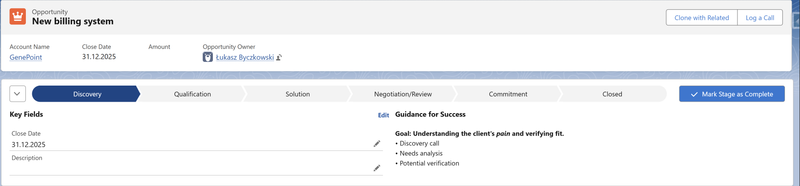
Discovery
Goal: Understanding the client's pain and verifying fit.
Key activities: Discovery call, Needs analysis, Potential verification.
Qualification
Goal: Confirming the client can and wants to buy.
Key activities: Technical/Business workshop, Value proposition presentation, Budget & Stakeholder mapping.
Solution
Goal: Showing how we solve the problem (not just "what" we sell).
Key activities: Dedicated Demo/Presentation, Submission of initial concept/offer, Proof of Concept (optional).
Negotiation/Review
Goal: Agreeing on formal and business terms.
Key activities: Final contract submission, Legal and price negotiations, Discussion with "Economic Buyer."
Commitment
Goal: Formal signing of documents.
Key activities: Get signatures, Setting the start date (Kick-off).
How to Use Guidance for Success
Implementation Difficulty: ⭐☆☆☆☆ (1/5)
Development Required: Declarative (Sales Path configuration)
Time to Implement: 30 minutes - 1 hour
Where to Find It
When you open any Opportunity, look at the stage path at the top of the record. Click on the current stage (the highlighted one), and the Guidance for Success panel will appear. You'll see "Goal" and the list of key activities right there.
Working With Guidance Daily
At the start of your day: As you review your pipeline, click into each active opportunity and glance at the Guidance. It takes five seconds and resets your focus on what actually matters for that deal.
Before client interactions: Preparing for a call? Check the Guidance. If you're in Qualification, remind yourself that budget and stakeholder mapping should be on your agenda. If you're in Solution, make sure you're ready to show how you solve their problem, not just list features.
When you feel stuck: Sometimes deals stall and you don't know why. Open the Guidance and review the key activities. Did you skip something? Maybe you jumped to presenting a solution before truly understanding the client's pain. The Guidance helps you diagnose where you went off track.
Pro Tips
💡 Guidance is a reminder, not a script. You don't have to do every activity listed. "Proof of Concept (optional)" means exactly that—optional. Use judgment based on the specific deal.
💡 Read the Goal first. The activities are just suggestions. The Goal tells you the why behind this stage. If you understand the goal, you can adapt your approach to fit the situation.
💡 Combine with the Opportunity Checklist. Guidance tells you what to do. The Checklist confirms you did it. They work best together—Guidance for planning, Checklist for accountability.
💡 Key Fields make it even better. Your admin can add up to 5 key fields per stage—the most important information to fill out at that point. Instead of scrolling through the entire record, you see exactly which fields matter right now, right next to the Guidance. Ask your admin to set this up if it's not there yet.
Great salespeople don't keep everything in their heads—they use systems that remind them what matters. Guidance for Success is your quiet coach, always there when you need a nudge in the right direction. Click, read, act.